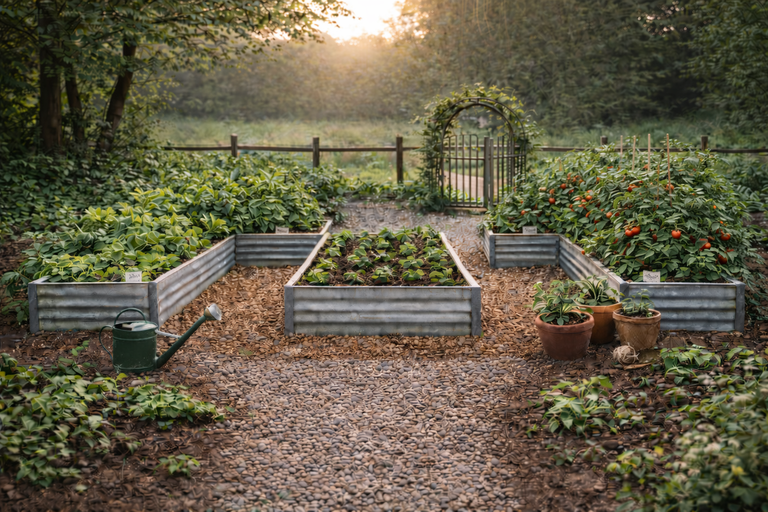
Raised Bed Gardening Part 3: Growing & Maintaining You Garden

This post may contain affiliate links. As an Amazon Associate, I earn from qualifying purchases at no additional cost to you. I only share products I truly love or would use in my own home..
Raised Bed Garden Care: What to Do After Planting
There’s a quiet shift that happens once your garden is planted—this is where raised bed garden care really begins.
The planning slows down.
The excitement settles in.
And suddenly, you find yourself standing there, looking at your beds and wondering:
“Okay… now what do I do next?”
🌿 Raised Bed Garden Care Tips for the Growing Season
If your garden is already planted—or you’re just about to get everything in the ground—this is the stage where things start to feel a little uncertain.
Not because you’re doing anything wrong…
…but because this is the part no one really explains clearly.
The good news?
👉 You don’t need to do everything perfectly.
👉 You just need to learn how to care for what’s already growing.
Let’s walk through this together 💛
🌱 What Might Already Be Growing Right Now
Depending on your timing (especially here in Zone 6b), your garden may already be starting to fill in.
You might be seeing those first little signs of life—tiny leaves, rows starting to form, or maybe even your first harvest-ready greens.
Right now, you may already have:
🥬 Cold-hardy crops in the ground:
Lettuce, spinach, kale, radishes, carrots, beets, and onions are often some of the first to go in.
These crops actually prefer the cooler temperatures, so even if the weather still feels a little unpredictable, they’re usually right at home.
🥔 Early crops planted:
Potatoes are often already in the ground at this point, quietly doing their thing beneath the surface.
🌿 And in the background:
You might also have seedlings hardening off, trays of plants waiting for their turn, or warm-season crops like tomatoes and peppers getting close to planting time.
Every garden looks a little different at this stage—and that’s exactly how it should be.
🌤️ Early Season Care vs Warm Season Care
Not everything in your garden needs the same kind of attention right now, and that’s where things can feel confusing.
It helps to think of your garden in two simple groups.
🌱 Early Season (Cool Crops)
These are your greens and root crops—the ones already in the ground.
Right now, they’re focused on getting established.
You might not see rapid growth yet, and that’s completely normal.
At this stage, your job is simple:
- Keep the soil consistently moist (not soggy)
- Watch for any major temperature drops
- Give them time to settle in
These plants aren’t in a hurry—and you don’t need to be either.
☀️ Warm Season (Coming Soon or Newly Planted)
This includes tomatoes, peppers, cucumbers, squash, and other heat-loving plants.
If they’re not in the ground yet, they’re probably getting close.
If they are already planted, they may look like they’re just sitting there doing nothing for a bit.
That’s normal too.
These plants are working on building strong roots first. Once the warmth really sets in, they’ll take off quickly.
Right now, focus on:
- Giving them time to adjust
- Making sure they’re not crowded
- Letting them gradually get used to full sun
💧 Watering (The Part That Confuses Almost Everyone)
One of the most common questions with raised bed garden care is knowing how much to water.
And honestly, it’s because there isn’t a perfect schedule.
You might see advice like “water every day” or “water every three days,” but real gardens don’t work that way.
Instead, the best thing you can do is start paying attention to your soil.
A simple way to check is just using your finger.
If the soil feels dry an inch or two down, it’s time to water.
If it still feels slightly moist, you can wait.
Over time, this becomes second nature.
If you’re ever unsure, there are a couple of simple tools that can make this feel a lot less like guessing.
A moisture meter with a longer probe can be especially helpful, since it allows you to check deeper into the soil where the roots actually are—not just the surface. It gives you a clearer picture of what your plants are really experiencing below ground.
And if you find yourself getting busy or want a little more consistency, a programmable hose timer can take some of that pressure off. Whether you’re using soaker hoses or a sprinkler setup, it helps keep watering steady without needing to think about it every day.
Neither of these are necessary, but they can make things feel a little easier and more consistent as your garden grows.
🌿 What your plants might be telling you
Sometimes your plants will give you little clues.
Yellowing leaves, drooping, or slow growth can all feel alarming at first—but they’re often just signals to adjust slightly.
Overwatering can make plants look droopy even when the soil is wet.
Underwatering usually comes with dry, crumbly soil and plants that don’t bounce back.
The goal isn’t perfection—it’s consistency.
🌿 Feeding Your Garden (Keeping It Simple)
As part of your raised bed garden care routine, feeding your plants doesn’t need to be complicated.
If you started with good soil, you’re already in a great place.
Adding a little compost or an organic fertilizer every few weeks is usually more than enough to keep things moving along.
If you’re looking for something a bit more straightforward or easy to mix and apply, a complete, water-soluble fertilizer can also be a helpful option. These types of fertilizers are designed to give plants a balanced boost and can be especially useful during periods of active growth.
You don’t need to use a lot—just an occasional feeding alongside good soil and compost is usually all your garden needs.
You might notice that some plants seem to need a little more than others.
Leafy greens tend to be fairly easygoing.
Heavier producers—like tomatoes, peppers, and squash—will appreciate a bit more support as they grow.
🐛 Pests & Imperfections (Without the Panic)
At some point, you’re going to notice something that doesn’t look perfect.
A small hole in a leaf.
A little discoloration.
Maybe even a bug or two.
It’s easy to immediately think something is wrong—but most of the time, it’s just part of having a real, living garden.
You don’t need to react to every little thing.
Instead, just observe.
If damage spreads quickly or becomes severe, then it’s worth addressing. Otherwise, a few imperfections are completely normal.
And honestly, a garden that looks a little lived-in is usually a healthy one.
If you do find that something is starting to spread or become more persistent, there are some gentle, more natural ways to step in without overwhelming your garden.
Simple options like neem oil or a light dusting of diatomaceous earth can help manage common pests while still keeping things balanced. These types of treatments are often enough to get things back under control without needing anything too harsh.
As with most things in the garden, a light touch usually goes a long way.
🌿 Companion Planting (Keeping It Simple)
You don’t need to memorize complicated charts for this to work.
A few simple pairings go a long way.
Tomatoes grow well with basil and onions.
Carrots pair nicely with lettuce and onions.
Peppers benefit from being near marigolds.
Just as important is knowing what not to crowd together.
Beans and onions don’t tend to do well side by side.
Tomatoes and brassicas are better kept in separate areas.
And most importantly, giving plants enough space is often more helpful than any pairing.
If you’d like to go a little deeper into companion planting, there are more detailed guides that break down plant relationships, spacing, and pest-reducing combinations in a bit more depth. The Old Farmer’s Almanac offers an easy-to-read companion planting chart that can help you plan with confidence.
These can be helpful as your garden grows and you start experimenting with different layouts and plant groupings. But even then, it’s best to treat them as a guide—not a set of strict rules.
Every garden is a little different, and part of the process is learning what works best in your own space over time.
⚠️ How to Tell If Something Is Actually Wrong
One of the hardest parts of gardening in the beginning is knowing what’s normal and what isn’t.
A few things that might worry you at first are actually very common.
Lower leaves turning yellow can simply be part of natural growth.
Plants wilting in the middle of a hot day often perk back up in the evening.
Slower growth early in the season is completely expected.
If something seems off, give it a little time before assuming the worst.
Your garden is constantly adjusting—and most of the time, it works itself out.

🔁 Mid-Season Adjustments (You’re Allowed to Change Things)
This is something that doesn’t get talked about enough.
You are absolutely allowed to adjust your garden as the season goes on.
If something isn’t thriving, it’s okay to pull it out and try something else.
If something is doing really well, you can plant more of it.
Gardening isn’t about sticking to a perfect plan—it’s about responding to what’s actually happening in your space.
Succession planting is a great example of this.
As you harvest things like lettuce or radishes, you can replant those same spaces and keep the garden producing.
💛 Nothing Is Perfect Yet — and That’s Normal
At this stage, your garden might look a little uneven.
Some areas may be full and thriving.
Others might still look a bit sparse or patchy.
That doesn’t mean anything is wrong.
Early gardens often look a little messy. Growth happens at different speeds, and not everything fills in at once.
Over time, those spaces will start to come together.
What feels incomplete now will slowly turn into something full and abundant.
🌿 Final Thoughts
Right now, your role isn’t to control every detail.
It’s to:
- Pay attention
- Make small adjustments
- Support what’s already growing
If you stay consistent with watering, give your plants space, and allow things to develop naturally, your garden will do more than you expect.
And before long, you’ll start seeing the results of everything you’ve put into it.
🌱 Coming Next
In the next post (Part 4), we’ll talk about harvesting, preserving, and making the most of everything your garden produces.
If you’re following along with this series, you’re exactly where you need to be.
💛If this is your first season, take a breath. You’re doing better than you think. 🌿✨
⭐ Save this post or come back to it throughout the season — it’s meant to be a gentle guide, not a checklist.